
i.MX93 – why all i.MX users should care
Just as many customers settle into production with i.MX8, taking advantage of the better price/performance vs i.MX6, NXP’s first i.MX9 processor has come along, in dual-core form – hitting the “sweet spot” of a broad feature set but without too many expensive, power-hungry multimedia bells and whistles. Wherever you are in the project lifecycle, we think it demands a close look.
- Dual Core ARM Cortex-A55 is plenty of processor for most industrial applications. This is a powerful core running at up to 1.7GHz, and the broad range of embedded applications that we see will have plenty of room to grow into this SoC. It’s an incremental improvement on the Cortex-A53 seen in most i.MX8 variants. Quad-core means more energy and more cost, so why have it unless you really need it? For power-users, and multimedia-hungry applications the i.MX8M Nano, Mini and Plus already offer a range of excellent solutions, and for power-users, the i.MX95 will come later next year.
- It’s a relatively inexpensive processor. In terms of system-on-module price think less than i.MX6 Solo or i.MX8 Nano. While it’s not as cheap as our module family’s very low-end – the STM32M1 or i.MX6 Ultralite – it’s a price-performance winner. Unless the project needs high-end multimedia, or is too cost-sensitive, it’s going to serve the vast majority of embedded projects as a workhorse.
- It’s available for 15 years, in NXP’s longevity program. As well as supporting this, as usual we are offering a contractual commitment to 10 years’ supply. None of our competitors existed when we launched our first SoM in 1998, and many will have disappeared by 2038 so longevity, alongside the quality of support, remains a key advantage to our customers.
- Dual GBe. Ethernet remains the single most enduring and important interface for industrial and transportation applications. Many projects need dual Ethernet, and it’s good to see this standardised.
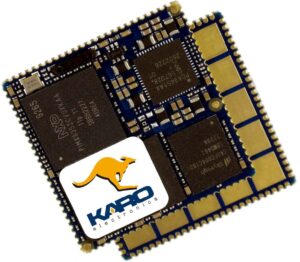
QS93 solder-down module with i.MX93
- LVDS display. For i.MX8, LVDS and RGB display interfaces were widely deprecated in favour of MIPI-DSI, which turned out to be unsuitable for many industrial applications, lacking integrity in harsh environments, and short of availability of usable long-lifecycle displays. i.MX93 brings back LVDS (alongside the other display types), and we’re going all-in on the interface that our customers actually want and use.
- No sexy 3D GPU. While there are 2D graphics capabilities within the PXP (pixel pipeline), there’s no GPU as such. Most industrial designs don’t need the high-end touch and gesture GUI of the mobile phone, and the saving in cost and energy is pretty significant. This brings us full circle to a world of projects without a compulsory heatsink, as was the case 10 years ago.
- “microNPU”. This is a 0.5 TOPS ML/AI engine (compare with 2.3 TOPS in i.MX8M Plus). Still plenty of capability for non-video applications. You may think that any ML/AI engine at all is more than you needed, but in fact most use-cases that we see could use AI in some way, and having the NPU keeps that option open.
- Simple and effective low-power support. Instead of traditional DVFS, the i.MX93 offers a simple system called Energy Flex. Alongside multiple sleep modes, there are 3 “run” modes (low-drive, standard and overdrive). In overdrive, the cores are clocked at 1700MHz and with high speed DDR4 expect exceptional performance. In the low-drive mode it’s possible to maintain sub-500mW consumption – ideal for battery-powered and thermally constrained projects.
- All the usual interfaces as well as enhanced security features. USB, CANbus, UARTs, SPI, I2C, audio – no “misses” in the connectivity list. No PCIe or USB 3.0, but these are not mainstream in embedded projects.
- Great in a solder-down module. The improved thermal conductivity makes no-heatsink operation viable, much more so than i.MX8.
Our customers can take advantage of pin-compatibility in both the solder-down and SODIMM versions of the module. And both feature dual Ethernet for the first time. Devkits are available now from stock, and volume modules from Q1 24.